Transit wayfinding system
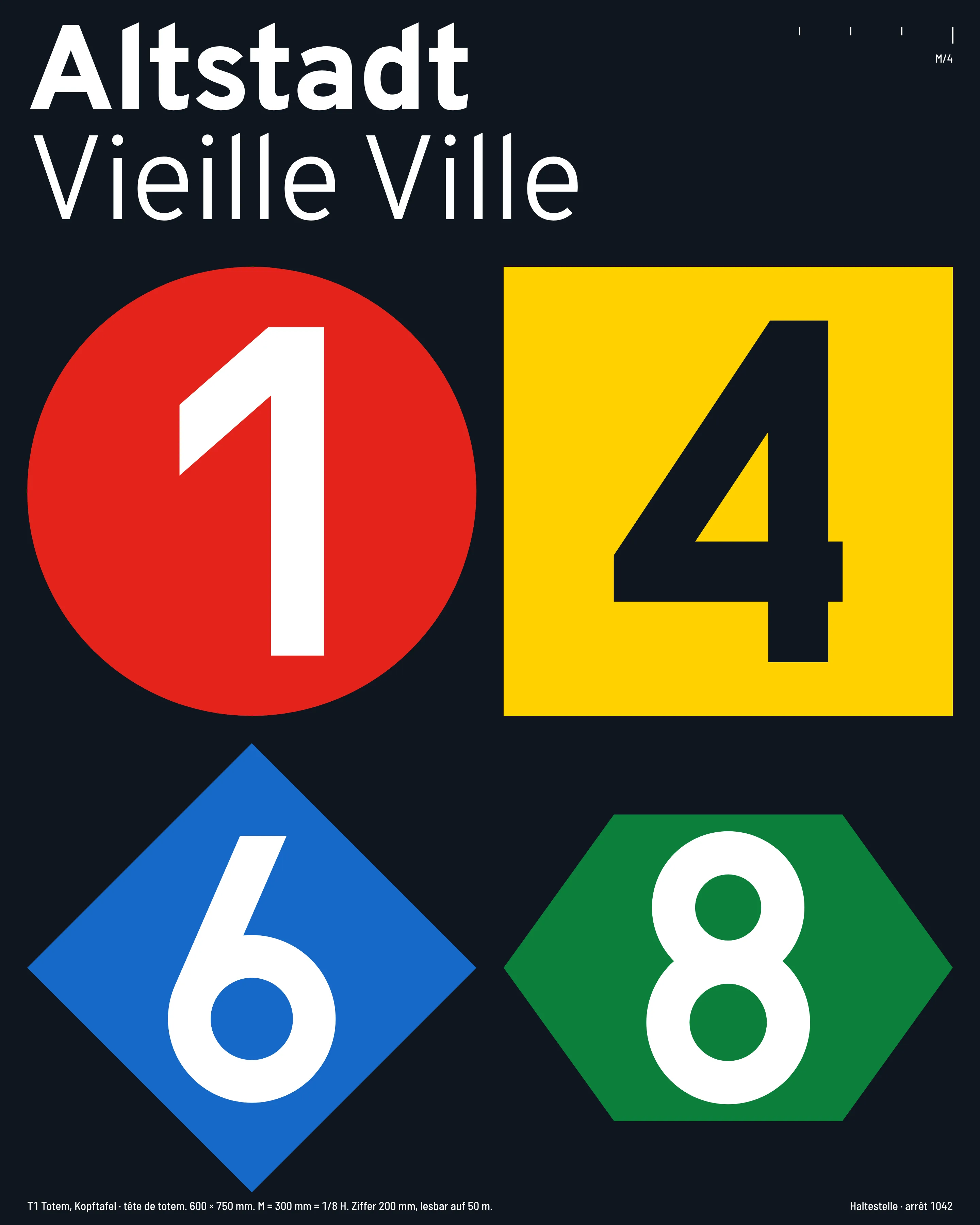
One bilingual sign system for 14 tram and bus lines and 212 stops, retrofitted to the steel posts of three merged operators.
Brief
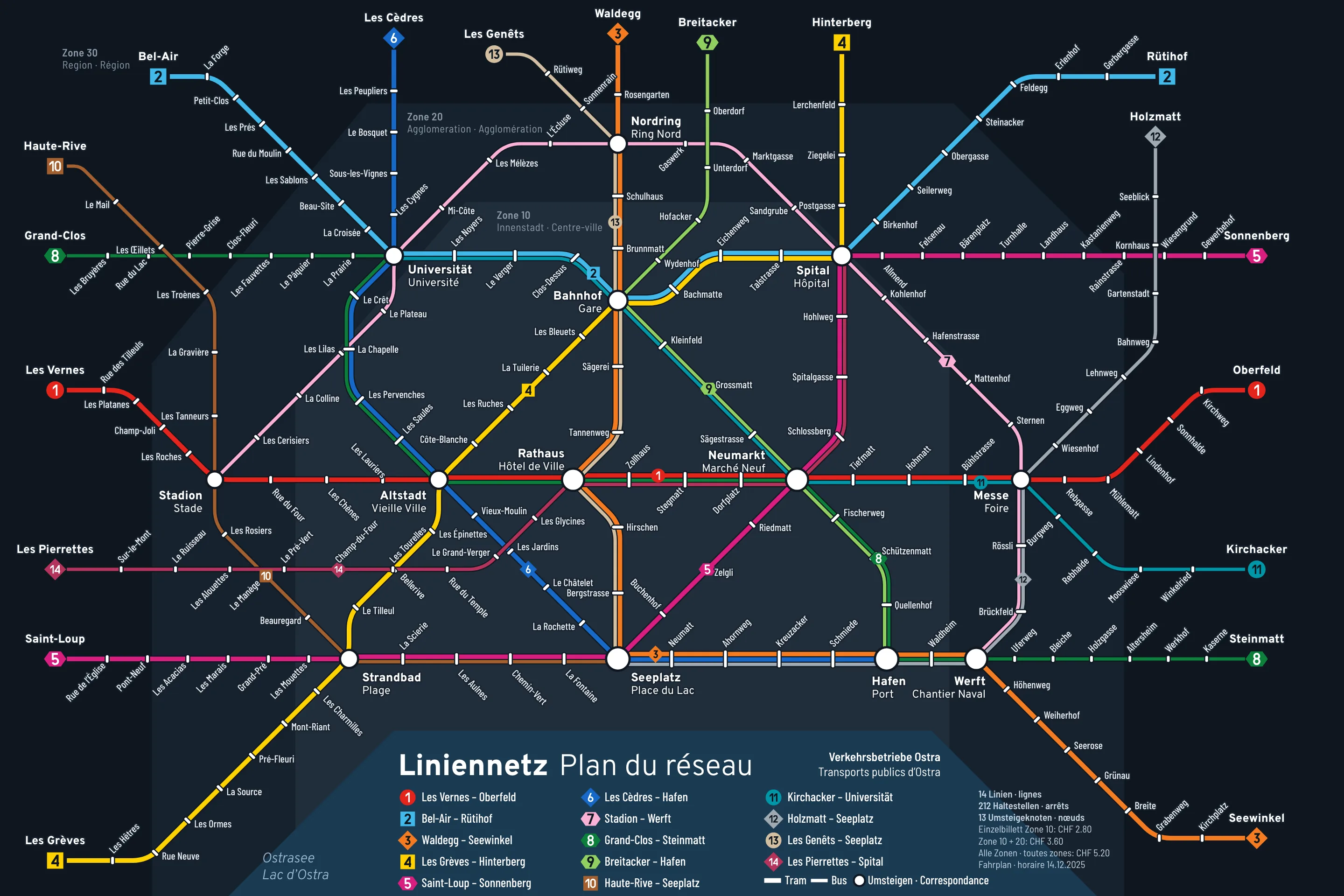
Ostra is a lake city of two languages. In 2023 three operators merged into Verkehrsbetriebe Ostra and left behind three sign systems, spread over 14 tram and bus lines and 212 stops. A rider changing at Bahnhof could meet all three on one platform, with the same line number set at three sizes in three typefaces.
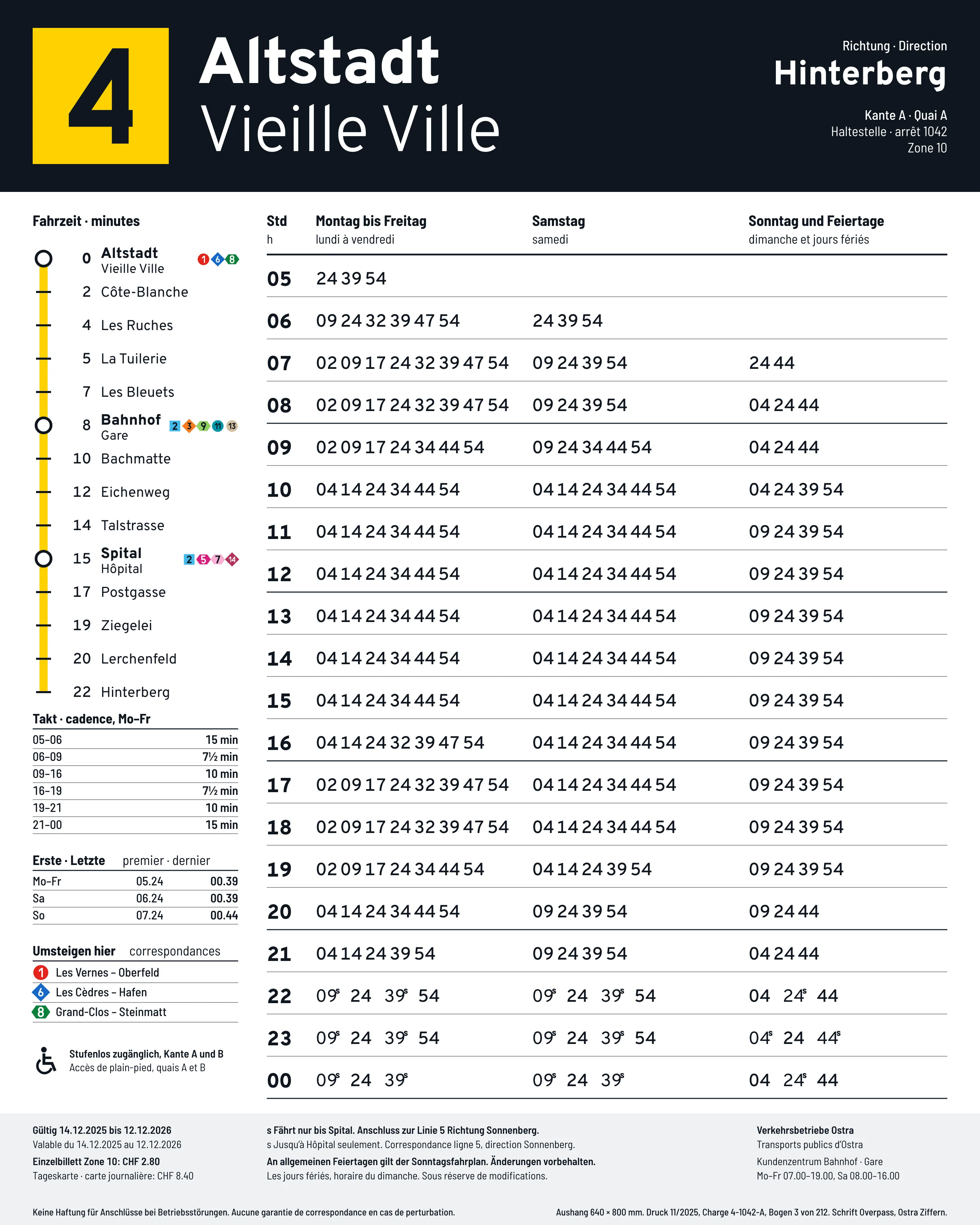
I was asked for one system that a person in motion could read, in German and French, on everything from a stop flag to an underpass. Before drawing a sign I rebuilt the network as data: 14 routes, 13 interchanges, 212 named stops. The diagram below is generated from that file, and so are the timetables and the departure display.
Constraint
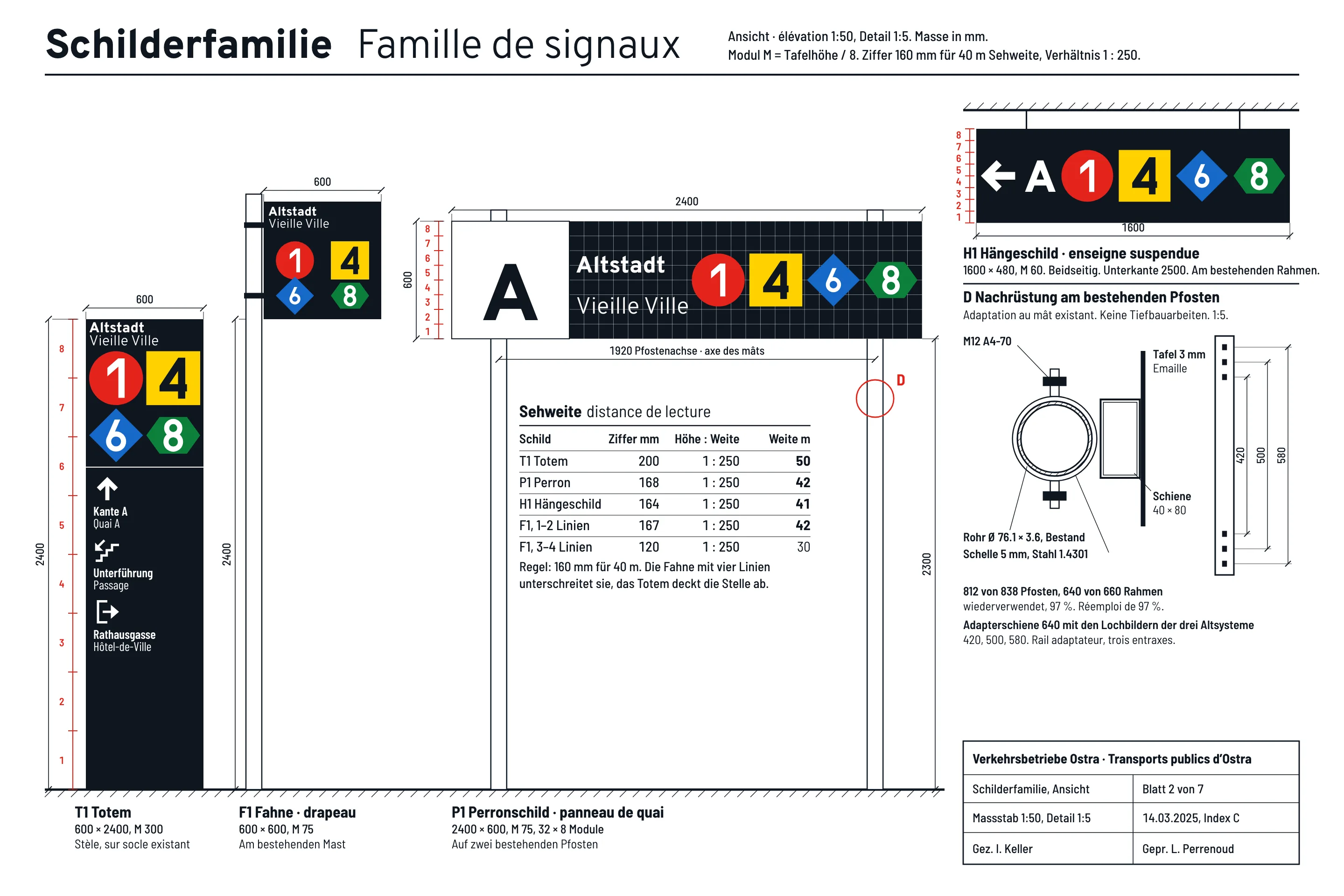
Signs had to work at 40 m for people walking towards them. The budget had no line for civil works, so every sign had to hang on a post or frame already in the ground, and the three old systems drilled their frames at three different hole spacings: 420, 500 and 580 mm. I counted them first: 838 posts and 660 frames.
Two more limits shaped the rest. Pedestrian underpasses at Bahnhof sit at about 15 lux. And roughly one man in twelve in the catchment sees colour differently, on a network that had always told its lines apart by colour.
Decisions
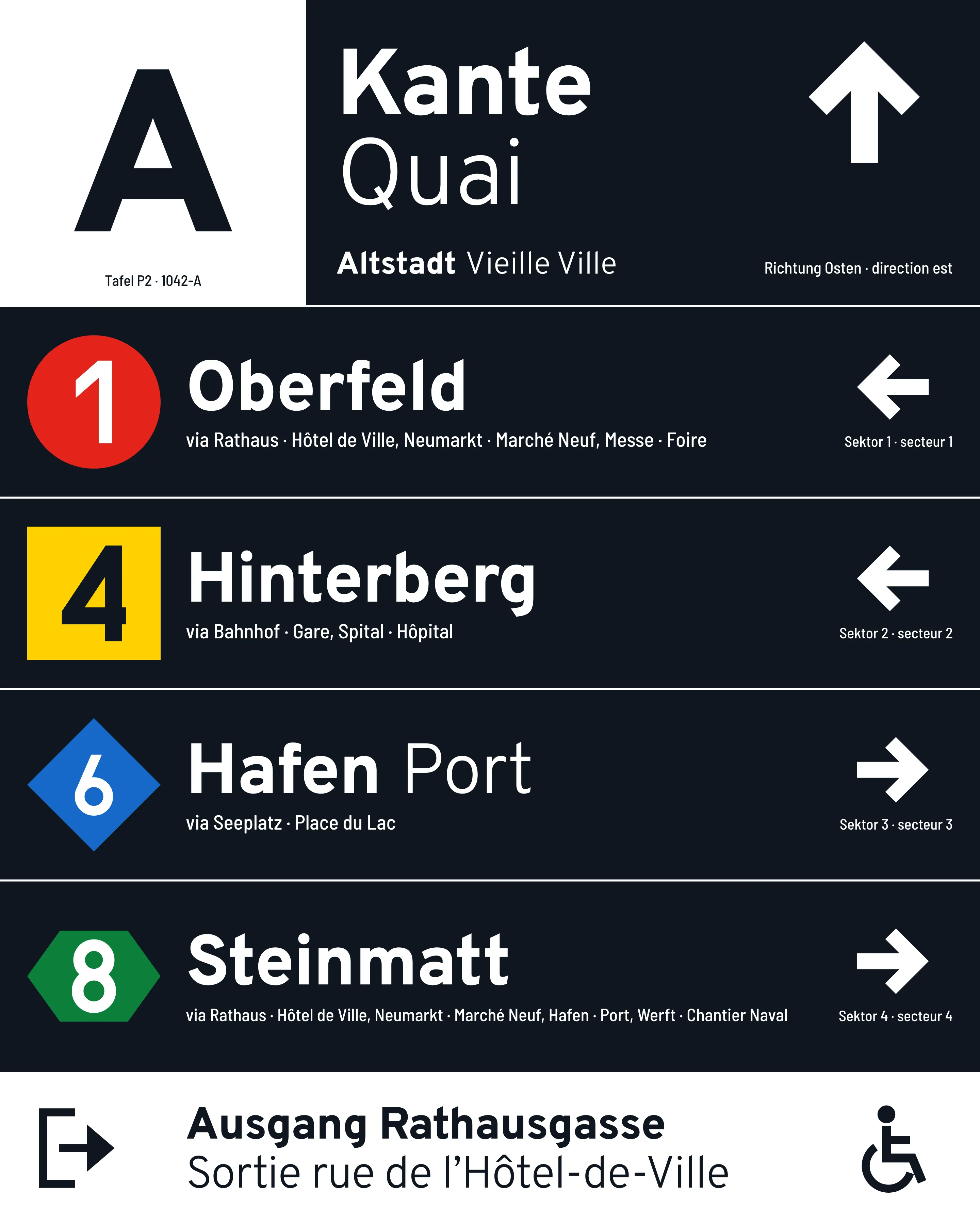
The number comes first. The old signs led with stop names and operator marks and gave the line number a small tab. On the new ones the numeral is the largest thing on the panel, at a ratio of 1:250, so 160 mm reads at 40 m.
Every sign is built on a module of one eighth of its own height. I tried sixths, which made blade numerals too big for the frames, and tenths, which put fractions of a millimetre into the steelworker's drawings. Eighths gave 300, 75 and 60 mm. The stop flag with four lines is the one sign that misses the target: its numerals are 120 mm and read at 30 m. I left that, because the totem at the same stops carries the distance.
The retrofit is one part: a 640 mm adapter rail drilled for all three hole patterns, clamped to the existing tube. It let us keep 812 of the 838 posts and 640 of the 660 frames. The other 26 posts were corroded through at the base and were replaced in their existing sockets by the operator's own maintenance crew.
Colour and numerals
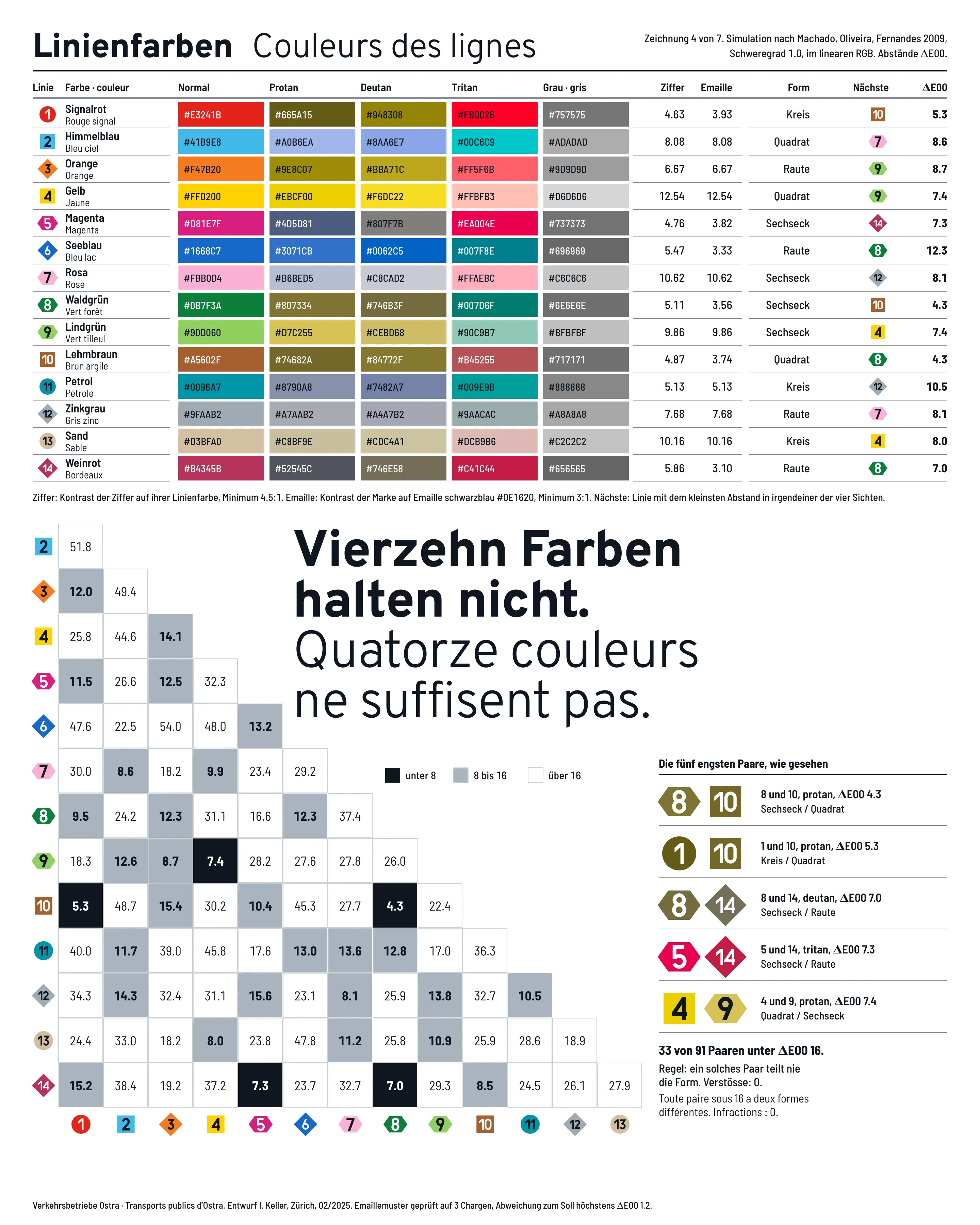
Fourteen colours cannot stay apart for everyone. I simulated the set for protan, deutan and tritan vision and measured every pair: 33 of 91 fall below a ΔE00 of 16, and the worst, lines 8 and 10, reach 4.3. Tuning moved the problem around, and pushing further turned orange and lime into mud. So colour became the third signal, behind the number and a shape. Giving trams circles and buses squares was the obvious rule, and I rejected it because lines 8 and 10 are both buses. Instead the four shapes are assigned so that no pair under 16 shares one. Each numeral has at least 4.63:1 on its own colour.
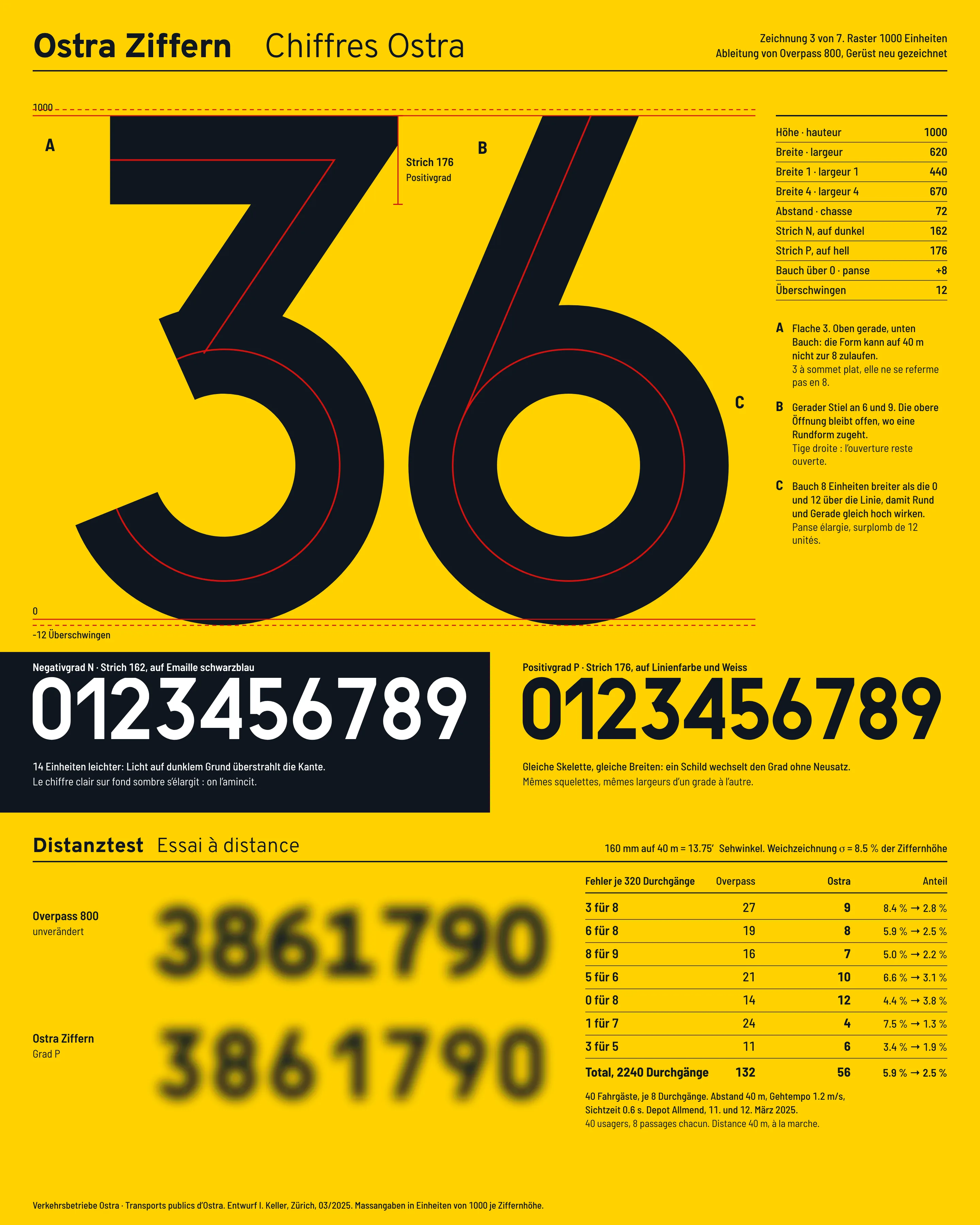
A whole typeface was out of budget and not needed: Overpass handles the names. I redrew only the digits. The 3 has a flat top so it cannot close into an 8, the 6 and 9 have straight stems, and light-on-dark numerals run 14 units thinner than dark-on-light to offset halation. In a field test with 40 riders at 40 m, confusions fell from 132 to 56 in 2240 passes. The pair 0 and 8 barely moved, from 14 to 12. I did not find a fix for that without making the 0 look like something else.
“We expected the argument to be about the posts. Ines arrived with a spreadsheet of all 838 of them and we never had that argument.”
Two languages
One proposal was to follow the language border and sign the west in French and the east in German. Most trips cross that border, so it was dropped in the first week. Both languages now appear at the same size in a fixed order, German in bold and French in light. Weight separates them, which meant the slash could go; at 40 m a slash is the first thing to disappear. Place names with no translation stay as they are, as on Hinterberg and Les Grèves.
Below ground
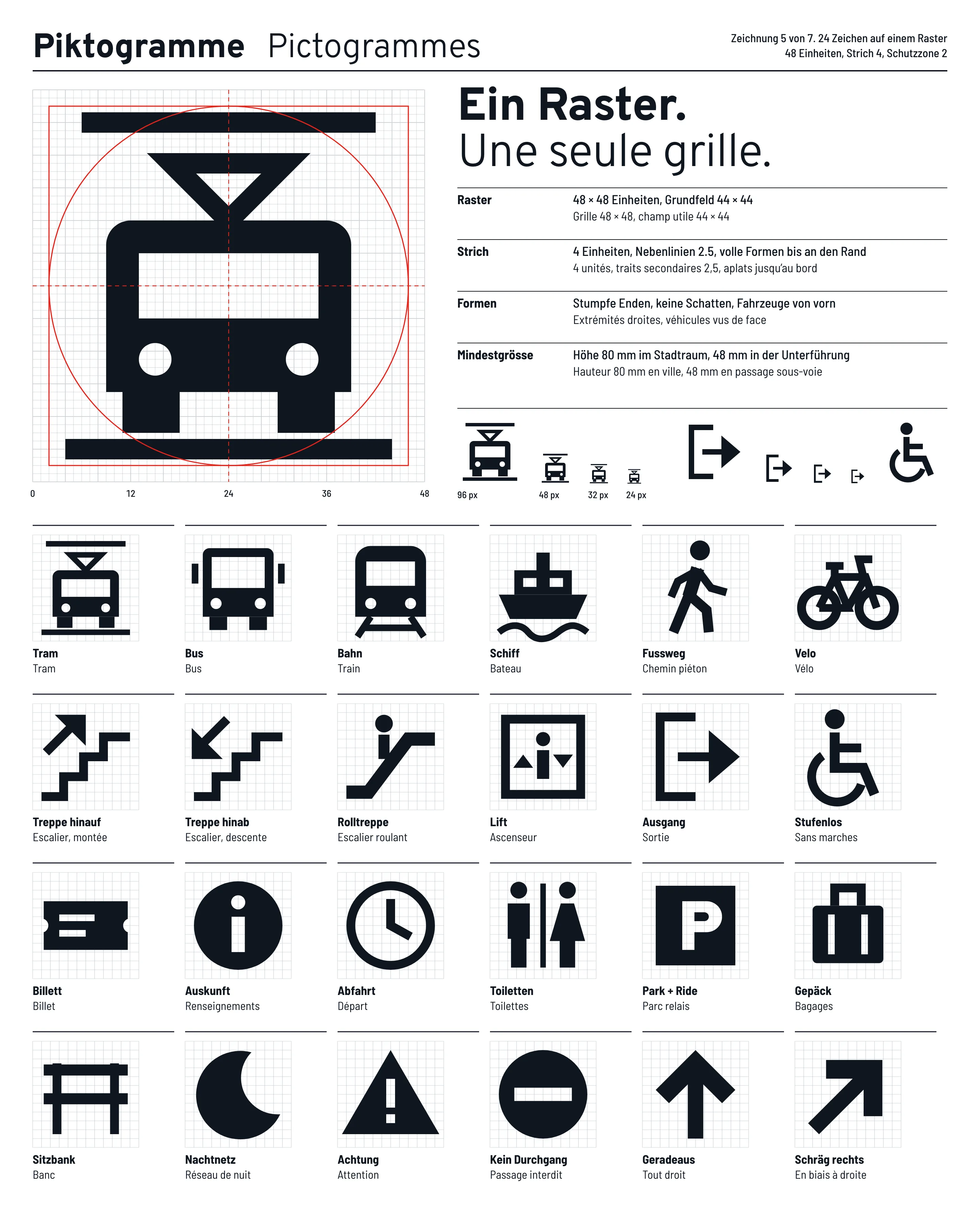
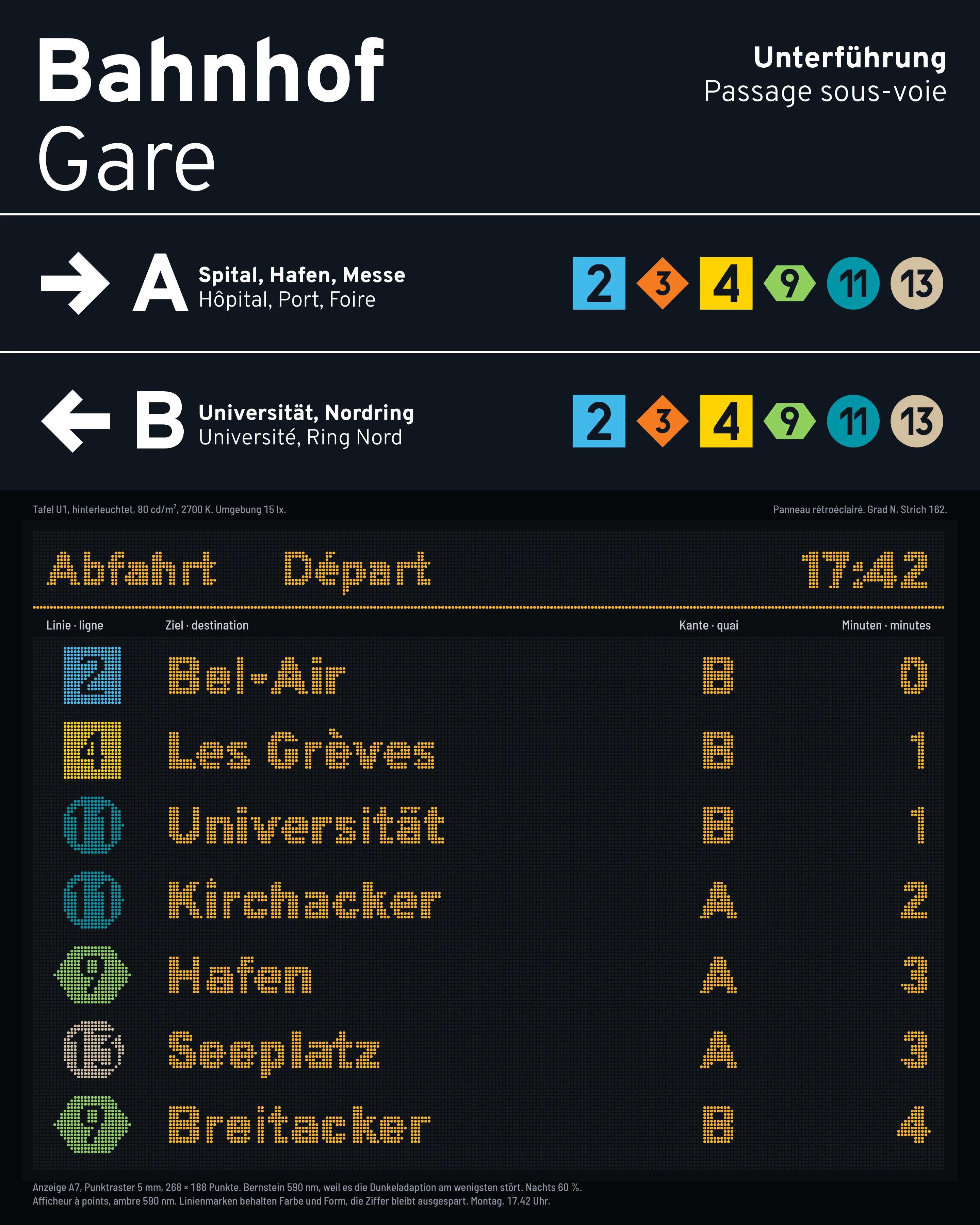
The underpass at Bahnhof is the only place with power to spare, so it gets a backlit panel at 80 cd/m² and a dot-matrix display. I specified amber at 590 nm because it disturbs dark adaptation least. White was brighter on the bench and worse after a minute in the passage. The marks keep their colour and shape on the display and the numeral is cut out of them. The same 24 pictograms run from the display surround to the stop flags, all on one 48-unit grid.
- 212
- stops re-signed in 34 weeks
- 97 %
- of posts and frames reused
- −58 %
- numeral confusions in the field test
- CHF 18'200
- average cost per stop
Result
Installation ran from April to the timetable change on 14 December 2025, about six stops a week, with no new foundations. The total came to CHF 3'858'400 against an estimate of CHF 6'100'000 for new foundations.
In the operator’s March 2026 survey, riders who reported boarding the wrong line fell from 11.4 % to 6.1 %. Complaints about signs are now mostly about the four-line stop flags, which is the compromise I expected to hear about.
Credits
- Design
- Ines Keller
- Steelwork and retrofit engineering
- Lena Perrenoud
- Network data and timetables
- Matteo Brandt
- Field test and vision
- Jonas Hug
- French editing
- Aline Rochat
- Enamel production
- Priska Amrein